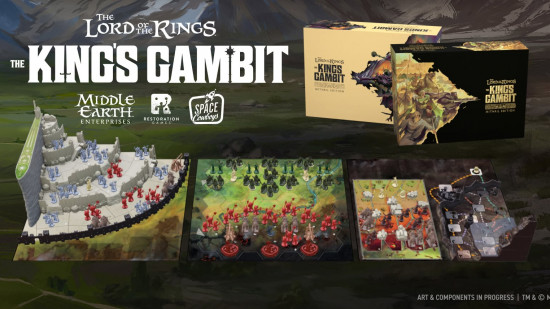
The Lord of the Rings: The King’s Gambit, a new board game set in Middle-earth, launched on Kickstarter today. Well, I say ‘new’. It’s a reimplementation of The Queen’s Gambit, a well-loved thematic Star Wars game from the 2000s. This new version promises the same cinematic gameplay, but co-designer Justin Jacobson tells me to expect a far “beefier”, better-balanced experience.
Jacobson, along with Restoration Games co-founder and lead designer Rob Daviau, is revamping an epic, multi-platform strategy battle. One to four players play as either the Shadow or the Free Peoples, aiming to win the trilogy’s historic war. You’ll need to juggle the battle on Pelennor Fields, as well as a siege on Minas Tirith.
Success on either of these two battlefields could net you victory, but keep an eye on the board’s third portion: Mount Doom. Here, Frodo battles his own willpower to try and cast the Ring into the volcano – and whether he does also determines the game’s winner.
Restoration Games’ crowdfunder, running from September 29 to October 20, is for two different deluxe versions of a game that’ll later come to retail. One costs $199, while another ‘Mithril Edition’ sells for $499. Both use armies of minis and 3D, multi-layer boards to up the glamour.
So, why should you back it now? I asked Jacobson about the game’s different iterations, as well as the exciting quirks of the new design:

Wargamer: What are the major differences between this and The Queen’s Gambit?
Justin Jacobson: The biggest thing was to make the decision space a little more interesting and a little beefier for modern hobby gamers.
The original game had action cards with two actions on each card. You program your cards for the round, and then on your turn, you flip up the next card in your row and decide which action to take. That in itself is a very clever system, because you might plan on doing one thing, then by the time your turn comes, the state of the game has changed so much you change your mind.
So, one of the cool things we added is called Resolve. Each action has a little icon that looks like algebra: ‘activate X squads’, right? You have Resolve tiles for the round (two ‘one’s and two ‘two’s), and when you decide your action, you also decide which Resolve token to use. It might not seem like much, but two is double one, so it can become quite a powerful decision.
Another thing in the original game was bonus cards for meeting certain goals. Basically, you’d end up playing six cards in the row and having a very powerful moment, but it wasn’t great for the other player sitting and watching you take a bunch of turns in a row.
We now have formal objectives you get at the start of the game. There’s 10 of them, but you’re only choosing five, so it might give different direction from game to game.
One of the main rewards of these cards is Momentum. Momentum lets you add an additional ‘one’ to your Resolve value. You can now go up to a maximum of four – and ‘activate one Orc squad’ versus ‘activate four Orc squads’ is a massive difference. Now you’ve got to decide when to spend that Momentum and what on. That change just made the game so much more strategically robust. I think hobby gamers are going to really enjoy that.
WG: How differently do the Free Peoples and the Shadow play?
JJ: Another thing we wanted to do was increase the game’s asymmetry. There’s some in the original game, but we wanted to highlight it. One of the main changes is that each side now has two win conditions rather than one: a military victory and a ring victory.
The Shadow forces are trying to overrun Minas Tirith, so their military victory requires them to have a majority of miniatures in the top level of Minas Tirith. This was the Queen’s Room in the original game, so it’s the most analogous victory condition to the original game.
On the other side, the Free Peoples are trying to stop the horde that’s assaulting them. There are three Orc encampments on the Pelennor Fields map, and the Free Peoples win a military victory if they defeat all of them.
These two parts happen on different battlefields. And they say the best defense is a good offense, so if somebody’s pressing you in Minas Tirith, you can put pressure on them on the Pelennor Fields to take their foot off the gas.
Then, there’s the opportunity for a ring victory. On a separate Mordor board, Frodo and Samwise are trying to get the ring to Mount Doom by travelling across various spaces. They have a Will track, and you’ll pull tokens from a bag to see how their will gets reduced as the journey gets more arduous. There’s also a really cool Gollum track to show which personality is in control – making the path easier or harder.
The Free Peoples win if they get to Mount Doom and survive, and the Shadow wins if Frodo’s will hits zero. What’s interesting about it is it’s not a direct battlefield like the others are. You have control over the battlefields, but you have influence over Mordor. The main way you do that is objectives. As well as Momentum, a lot of these cards put good tokens into the bag for the Free People – or bad ones for The Shadow.

WG: What aspect of the design excites you the most?
The game still surprises me. I was at a mini con last week, and I demo’d the game about 10 times, and I saw two or three things I’d never seen happen before. One of the Shadow players had literally all of their Corsair forces in Minas Tirith. I had a game where it came down to the last bag pull, and Frodo had one Will left, and he couldn’t pull a token that could save him.
It creates some really exciting moments. That diversity of game states will make it a really rich experience. That gives it a lot of legs. People will keep wanting to come back, because every game feels different.
WG: What do you get from the Kickstarter that you can’t get at retail?
Importantly, the gameplay is the same between all three editions, including the retail edition Space Cowboys is putting out next year.
The Limited and Mithril Editions basically come with a second box to give it more of an epic feel. That includes a 3D Minis Tirith and Mount Doom that are only in the limited editions. The boards are also a little bigger in these editions.
Plus, each class of miniature has a different color plastic in the Limited Edition, while the retail edition just has two different colors. The Mithril Edition also has all sorts of bonus miniatures.
For example, there’s a really cool hidden Eowyn mechanic, similar to the hidden queen in the original game. Eowyn is disguised as a regular Rohirrim rider at the beginning of the game, and you can reveal her to do a bunch of damage to the Witch King. We give you an extra Eowyn miniature so you can swap her in.
The Mithril Edition includes upgraded card racks, a little tea light that glows inside Mount Doo, card sleeves, dice trays, and more. We didn’t want to have stretch goals in this campaign, so everything we could think to include made it into its own edition. It makes it easier to reduce shipping and make sure everything arrives in good condition. All you need to decide is if you want to add a big neoprene mat that comes separately.
You can learn more about the game on the Kickstarter page. Want to learn more about this year’s best board games? Check out our dedicated guide, or join the Wargamer Discord to keep up with all our latest stories.
 Source: Wargamer