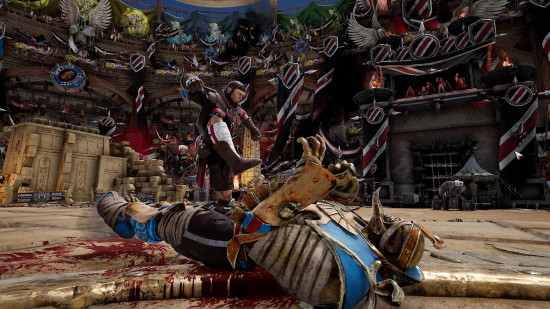
On Wednesday, specialist strategy game publisher Slitherine Games showcased Warhammer Blood Bowl, an upcoming revised digital edition of the game of fantasy footbal. Slitherine acquired the license and back catalogue for the Blood Bowl videogame series in July, with long time developer Cyanide Studio still at the helm. I went backstage at Slitherine’s offices in Milan, Italy, to talk to members of both teams and discover their plans for the franchise.
The new version of Blood Bowl will be, for many purposes, the old version of Blood Bowl. Warhammer: Blood Bowl runs on the same engine as Blood Bowl 3, albeit updated to the current edition of the tabletop game rules. The visible changes will be minor: a reworked UI, the new Bretonnian and Tomb Kings teams, and a seven-aside Rumble mode. Current Blood Bowl 3 players will get a free upgrade to the new game, and will carry across all their cosmetics and DLC, so while this is being marketed as a new game, in practical terms it’s a relaunch.
Programmer Mathieu Valero explains how the game is going to benefit from this reset; a series of incremental changes, many of them under the hood. To my great surprise, he says that coaches “play around 70-80% of their games solo” against the AI in the Eternal League. BB3’s AI was lamentable at launch, getting a major rework in 2025 as part of the season nine expansion. Even so, Valero is dismissive of its current state. The AI is “seemingly doing stuff”, he says, but the version coming in the relaunch is “actually doing things… looking for assists to blocks, or important passes”.

The headline feature for the relaunch is a new seven-a-side mode, Blood Bowl Rumble. “For Blood Bowl 3 we wanted to make 45 minute games, that was the goal when we started the project”, Valero says – but the team has recognized that’s just not possible. “We could remove all the animations, everything, there’s too much decision making happening in 11 versus 11”. Rumble came about from looking at the different quickplay modes that GW has released for tabletop Blood Bowl, but it’s not a direct adaptation of the tabletop ‘Blood Bowl Sevens’ mode.
“Sevens has Desperate Measures”, Valero says, “a super popular inducement where you roll a weird dice and weird stuff happens – but if we want to make the game more approachable, is it really worth it to introduce this completely alien concept that dovetails into weird stuff like wizards, even other specific inducements?” Hence why Rumble has a different name from Sevens: it may be a seven-player streamlined version of Blood Bowl, but “we want to keep some leeway about what the streamlining entails”.
Valero points to a number of small but impactful ways that two years of user data is being used to improve the game. “We had a lot of navigation issues because nothing useful was on the main page”, he says – that’s being overhauled to put the most commonly used features front and center, plus the ability for coaches to pin their favorites. Information about the upgrades that coaches pick for their players – and also the combos of upgrades, and sequence they choose them in – will feed into recommendations to help new players make better choices. AI coaches will use that same data, and – if you decide to build a league populated by a lot of bots – they’ll now make progress when paired against one another, not just when facing a human opponent.

The monetization model has also changed. New teams – which were previously sold using the in-game currency warpstone – will now be DLC. I can only call this a lateral move rather than a direct improvement until I see the prices, but it at least makes the actual cost of a team explicit, and makes it possible to wishlist teams and wait for Steam sales. But if you’re sitting on a stack of warpstone and want to use it on teams, you need to do that before the new edition drops.
Speaking to Valero and members of Slitherine’s marketing team, I get the impression that this version of Blood Bowl is expected to last. Valero says that the architecture it’s running on is flexible enough to survive live updates in a way that the earlier Blood Bowl 2 was not – he thinks it can handle any rules changes Games Workshop may throw at the tabletop game.
For those suspicious of Slitherine’s desire to support a mature game with a nearly full library of DLC, the studio’s marketing director Marco Minoli says that over 70% of the company’s annual revenue comes from games that are at least 18 months old. He also sees a substantial untapped audience for the game among sports game fans, particularly if the game’s single-player mode is right.

Slitherine is definitely a promising home for Blood Bowl. The studio has a good working relationship with Blood Bowl license owner Games Workshop, publishing several of the best Warhammer 40k games for strategy fans; more importantly, it has a track record of providing long term support for fairly niche strategy titles. It’s a safe pair of hands.
None of what’s being promised for Blood Bowl is big or flashy, but that’s no bad thing. The strength of Blood Bowl comes in large part from its community, an international society of tournament and league organisers who have sustained the tabletop game for decades, including many years when original IP owner Games Workshop ignored it almost entirely. That community wants a stable set of tools to facilitate digital Blood Bowl. We’ll find out later this year if Cyanide makes a smooth hand-off from Blood Bowl 3 to Warhammer: Blood Bowl, or if it fumbles the ball.
Excited, or dubious? Let us know in the Wargamer Discord community!
 Source: Wargamer