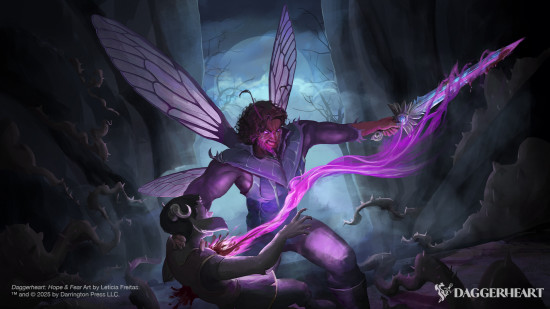
Daggerheart: Hope and Fear releases on August 25, and there’s been some serious hype for the RPG’s first expansion. It’s a substantial update to the system, with an entire new Domain and four new classes. I’m part-way through my review readthrough, and one of those new character options has already stolen my heart – the Warlock.
The Warlock class is relatively young in the world of TTRPGs (at least, when we’re talking about the market leader, D&D). It wasn’t introduced as a fully playable class until 2008’s Complete Arcane, a sourcebook for D&D 3.5e.
In its current form, the D&D Warlock is a charisma-fueled spellcaster who has far fewer spell slots than their companions – but refreshes them more often. They always cast at their highest level, and their Eldritch Invocations give them plenty of ways to modify and amplify their repertoire.
The Warlock is perhaps better known for its backstory, however. Wizards learn spells, and Sorcerers are born with their magical power, but a Warlock’s skill comes from a bargain. They’re forever tied to a Patron that grants them their abilities.
There’s such rich narratives to mine from this simple concept. The problem is, in Dungeons and Dragons, the concept isn’t properly realized mechanically. There’s no obvious link between pact-based magic and the kind of magic a Warlock uses. If a Patron appears in a D&D campaign at all, it’s because the players invented a way to introduce them, divorced from the actual rules.
Daggerheart takes a different approach. Here, a Warlock’s key class feature is its Patron’s Pact. Your agreement with a supernatural entity is manifested as Favor. You start play with three Favor, and you can spend it to activate a variety of abilities. The core class, for example, can spend it to add a Patron Die (d6, then d8 at level five) to a roll related to the Patron’s specific sphere of influence (love, war, death, and so on).

The Warlock’s subclasses unlock more ways to play with Favor. The Pact of the Endless can spend it to:
- Gain damage threshold bonuses
- Add advantage to intimidation rolls
- Clear hit points
- Inflict disadvantage on enemies
- Reduce incoming damage
- Give enemies Stress
- Debuff enemy attack dice
The Pact of the Wrathful, on the other hand, uses Favor to:
- Add Patron Dice to their damage total
- Damage attackers after marking HP
- Increase the range of their weapons
- Give enemies Stress
- Reroll damage dice
- Damage crowds after taking damage
This Warlock is tremendously flexible. But whether you want to be the party Defender, Blaster, or Support, everything you do is driven by Favor. As the sourcebook says, “a Warlock’s power is defined by the relationship they maintain with their benefactor”. Who your Patron is and how they feel about you matters.
Heck, you literally regain Favor by showing tribute to your Patron during downtime. You can also regain it by choosing it instead of Hope on a great roll though – so your build isn’t destroyed when you and your Patron are on bad terms.
The Warlock is another great example of what makes Daggerheart stand out among the most popular heroic fantasy RPGs. Its rules give you interesting tactical decisions, but narrative is the heart of every design choice. And, as someone who’s mainly into tabletop RPGs to tell stories, that gets me very excited.
Want a full review of Daggerheart: Hope and Fear? Keep an eye on the Wargamer website this week – or join the Wargamer Discord to get daily notifications about our articles. We’re also always up for a chat about your favorite games!
 Source: Wargamer