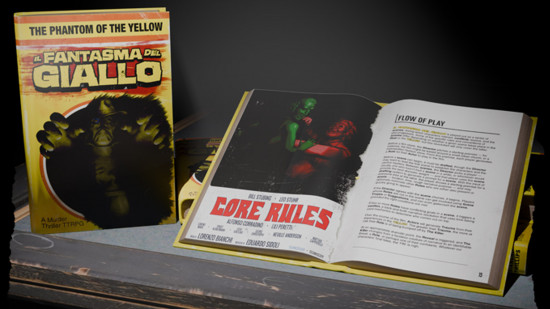
Il Fantasma del Giallo: The Phantom of the Yellow is a TTRPG about murder, disgraced actors hoping for one last chance, and trends in Italian cinema in the sixties and seventies. Players control actors who take on a variety of archetypal cinematic roles, as the lines between reality and fiction begin to warp and blur together.
Il Fantasma del Giallo is currently crowdfunding on Kickstarter, with the campaign set to conclude on the 22nd of July. It was created by Laurence Phillips, a designer based in the UK, who has previously worked on supplementary material for the games Spire and Legacy: Life Among the Ruins, and who was a writer for the BAFTA nominated video game Vampire Survivors.
We spoke to Phillips about the game, and the Italian cinematic tradition that inspired it.

Wargamer: Tell us a bit about Il Fantasma del Giallo.
Laurence Phillips: In the game, players take on the role of down on their luck and disgraced actors who have woken up without most of their memories, recording a series of murderous Italian exploitation films. The twist is that as soon as they start shooting their first film, they merge with their roles and enter a different reality where truth and lies are constantly shifting, and nothing is set in stone. Through a card based trick taking system, players will build the narrative of the film, and at the conclusion, a murderer is revealed, and the actors return to the real world changed by the trauma they have acquired and the truths established within the film world
Wargamer: Can you tell us about some of the game’s inspirations?
Phillips: It has various influences, most notably the sixties and seventies Italian tradition of murder mysteries, thrillers and horror films. It’s also influenced by metatextualist media like The Twilight Zone and the films of David Lynch.
Wargamer: Tell us about the design philosophy of the game.
Phillips: A lot of the design philosophy of this game is based around a personal approach that I have to fiction, which is that fiction isn’t real. I know that sounds obvious, but in a lot of fandom spaces, there’s a tendency to try to ‘find the real’ in the fiction.
Wargamer: Like establishing what’s cannon?
Phillips: Exactly, so I don’t want to provide a specific concrete setting from the game because I don’t want to detract from the spirit of creativity and spontaneity. What I will be doing is giving libraries and tables of prompts, ideas, and ways of coming up with things. The most constructive thing for creativity is providing loose guidelines that can direct players’ energy.
Wargamer: What’s the source of that name ‘Giallo’? That’s ‘yellow’ in Italian right? Why is the genre called Giallo?
Phillips: In Italy, ‘Giallo’ is just a term that describes a mystery story. So in Italy, Agatha Christie would be Giallo and Sherlock Holmes would be Giallo. But ‘Giallo’ means something else more broadly among film critics. Prior to the 1930s, there wasn’t a strong tradition of mystery stories in Italy. Then several mystery and detective stories got translated into Italian and distributed,and sold as pulp paperbacks with yellow covers, so people started to call these novels ‘Giallo novels’, because of the yellow covers.

Wargamer: And in terms of film and cinema?
Phillips: They’re a particular style of Neo Noir mystery story with certain recurring themes. The most important themes are that the world is corrupt and corrupting. That people who commit crimes don’t do it due to evil, but due to damage. They’re traumatised and broken, and they see the world differently from other people.
Wargamer: I see.
Phillips: Common elements are a central mystery, usually involving a murder. Often, the murders are quite visceral in a way that they aren’t in an Agatha Christie story. There’s a mistrust of authority, civilians are almost always the investigators, cops are often corrupt and venal, and jump to all the wrong conclusions. It often has very loose morals. It’s very violent and features a lot of drugs and lies. There’s also a lot of queer sexuality. There are shocking reveals, and it’s less about working the mystery out and more about enjoying the ride.
Wargamer: Where did the idea to make a TTRPG based on the Italian Giallo genre come from?
Phillips: I’ve been working on it on and off since 2018 or 2019. It has undergone a lot of shifts. It started life as a Giallo game, a TTRPG set in the world of a Giallo film. I ended up building on this almost Persona like second level, with a real world and another world, because I wanted to incentivise players to act within the tropes of a genre that they might not be familiar with.
Wargamer: You’re anticipating your players may not be familiar with Italian Noir?
Phillips: People like to exoticize this genre a bit, but they’ve seen murder mysteries, slashers, and Hitchcockian thrillers. If you combine elements from all three of those, then you’ve got a Giallo film. They’re murder mysteries with a bit more violence, suspense, sleaze, and ambiguity. What has been great is that, during playtesting, people who have never seen a Giallo film will tell me about what that they’ve made through play, and it’ll be a Giallo film.

Wargamer: So the game features a sort of two layered system with the players controlling characters, who are in turn playing roles. Can you talk a bit about that?
Phillips: People personalize very strongly with the characters they play in TTRPGs. Whether they mean to or not, they end up doing what they would do knowing the sort of story they are in, rather than what they might actually do. I want to encourage players to depersonalise, and by giving them this temporary role, they’re able to be brutalised, killed, or do horrible things without it feeling too personal.
Wargamer: So there are nine sets of roles that characters can take on?
Phillips: That’s right, archetypes, they’re sort of the game’s classes?
Wargamer: Would you say they’re closer to D&D classes or Powered By the Apocalypse playbooks?
Phillips: They’re more like playbooks. The general idea is that each actor has been typecast in their career, and that typecasting reflects a truth about them as a person, either ironically or literally. Each archetype represents a common character type that would appear in all kinds of films, and in Giallo films.
Wargamer: Can you tell us about some of them?
Phillips: Let’s say you’re a crook. In one film, you might be a low level gangster, or a corrupt cop, or a crooked salesman. But when you’re a crook, you’re someone who acts beyond the borders of legality. There’s the Downtrodden, who’s someone that’s forgotten, or abused. Then there’s the Lamb who is a seeming innocent, although they’re rarely an actual innocent.
Wargamer: Of the nine archetypes, is there one that you particularly see yourself in?
Phillips: As a creative, it’s hard not to see myself as the visionary. That’s the archetype for characters that value expression and interpretation, and they’re a bit weird and pretentious. That’s pretty close. Maybe also the inquisitor, the archetype that values truth, because I can be quite persnickety.
Wargamer: Going over to gameplay, you’ve said it revolves around cards and a trick taking system?
Phillips: All of the core mechanics use playing cards, rather than dice. When you get into a conflict, let’s say one character wants to phone the police and the other character wants to keep things quiet, both players define what’s happening in the conflict. Then they determine how dangerous it is, not just physically, but also emotionally, and narratively. Then players play rounds of bidding, where they draw cards according to their skills, and then they play these cards, lower cards are better. One player will play a card, and then narrate some fiction, then the other player responds with a counter bid. If it’s lower, then they talk about how they turn the tables, and if it’s higher then they talk about how they lose out in the exchange. The winner of the round can then decide to continue, escalate the situation, or give up.
Wargamer: What happens when players give up?
Phillips: They take the whole pile of cards that have been bid so far, and they gain it as trauma. Trauma is an escalating scale of how much danger their character is in, in the film. As characters gain trauma, they become more vulnerable, as the killer hunts higher trauma characters, but also gain more centrality to the plot of the film. Gathering trauma isn’t a bad thing, since when the actors return to the real world, they can use these trauma cards to resolve conflicts.

Wargamer: You’re exploring this idea of players who are controlling characters who have a blurred relationship with the roles that they’re playing. Are you also trying to blur the distinction between the players and their characters?
Phillips: (chuckling) I think I don’t even have to get players to do that, because they just do that already. If anything, one of my roles as a designer is building in enough stuff to separate players from their characters a bit more. I want the actors the players are controlling to be sympathetic people, but people who have done bad things, playing roles that can be pretty horrible and irredeemable. So I want to make sure that there is enough distance there so that the players don’t experience too much bleed. Since I know it can get quite intense when you’re controlling a character who has done bad things, or has very intense feelings.
Wargamer: So you’re trying to put some barriers in place there?
Phillips: Yes, one of the ways I’m doing this is by trying to encourage players to talk as though they’re looking through a camera rather than directly through their character’s eyes. So rather than saying ‘I walk into the room’, they might say ‘there’s a shot of my character entering the room’. You’d be surprised how much that helps.
Wargamer: Are there any final closing points that you want to raise?
Phillips: I think I’d say, If you’ve never heard of Giallo films, don’t be afraid. You don’t need to know about them. If you like mysteries, and playing with themes of forgiveness, redemption, vice, disenfranchisement, and obsession, and with queer themes, then you can give it a go. Ultimately, what’s important is theme, and there are some themes here that are deeply applicable.

For more TTRPG content from Wargamer, check out our list of the best tabletop roleplaying games. You’ll also find plenty of RPG fans in the Wargamer Discord server.
 Source: Wargamer