



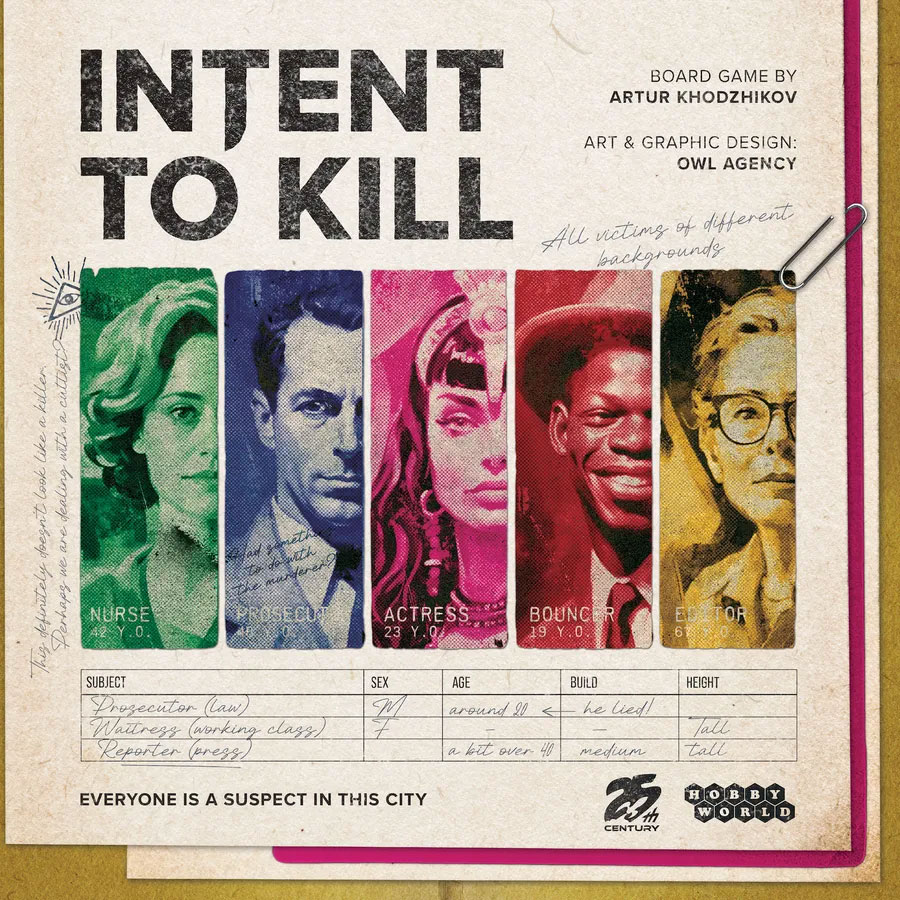
 I love a good murder mystery. I’ve watched every episode of Midsummer Murders. My “Read” shelf is heavy with detective novels, especially Scandi noir. Intent to Kill should have been a shoo-in for me. But instead it left me feeling decidedly meh.
Intent to Kill is a 2-player deduction game published by 25th Century Games. Intent to Kill takes about 60 minutes to play.
Gameplay Overview:
Intent to Kill is a 2-player asymmetric deduction game in which one player is the murderer while the other is the detective. It nominally supports up to four players, but our one attempt at an expanded count fell flat, and the game is clearly built for head-to-head play. A session runs about an hour once everyone knows what they’re doing, and it sits at a medium weight that plays a lot heavier than it is during the first few rule-heavy sittings.
The core loop is simple to describe. Over what is usually five rounds, the murderer kills one civilian each round while the detective questions witnesses, all of whom are played by the murderer, to work out the motive and the killer’s identity. There are two play modes, called Logic and Intuition, and the latter adds some depth (the rulebook nudges you toward a few rounds of the easier Logic mode before jumping into Intuition).
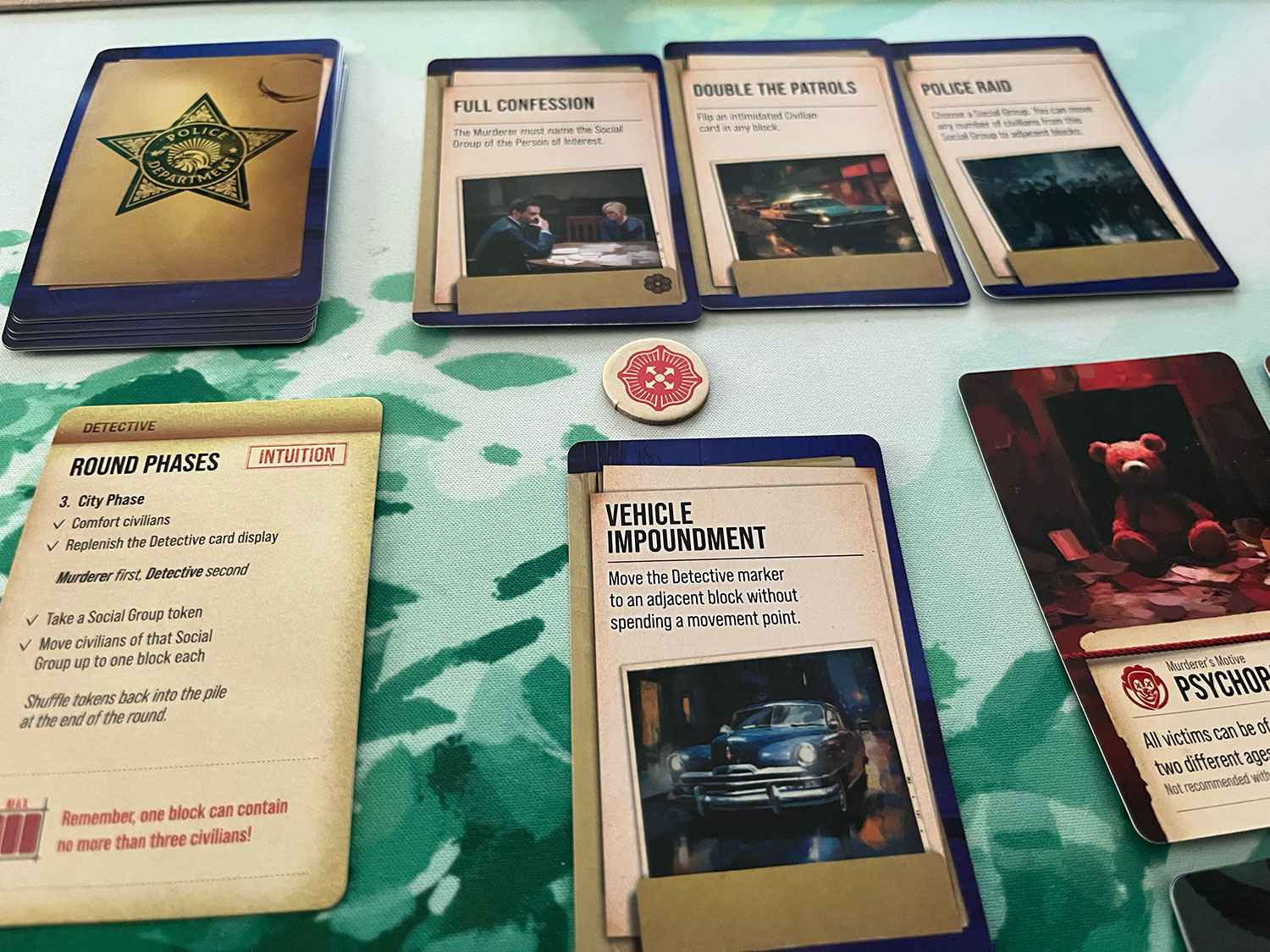
The detective also gets special actions tied to locations around the city board, like questioning two witnesses at once or running surveillance to get a better read on possible motives. Intuition mode layers on extra cards and tokens that both help and hinder the detective. The setup has a few more moving parts than that, but those are the pieces that actually shape how a game feels.
Game Experience:
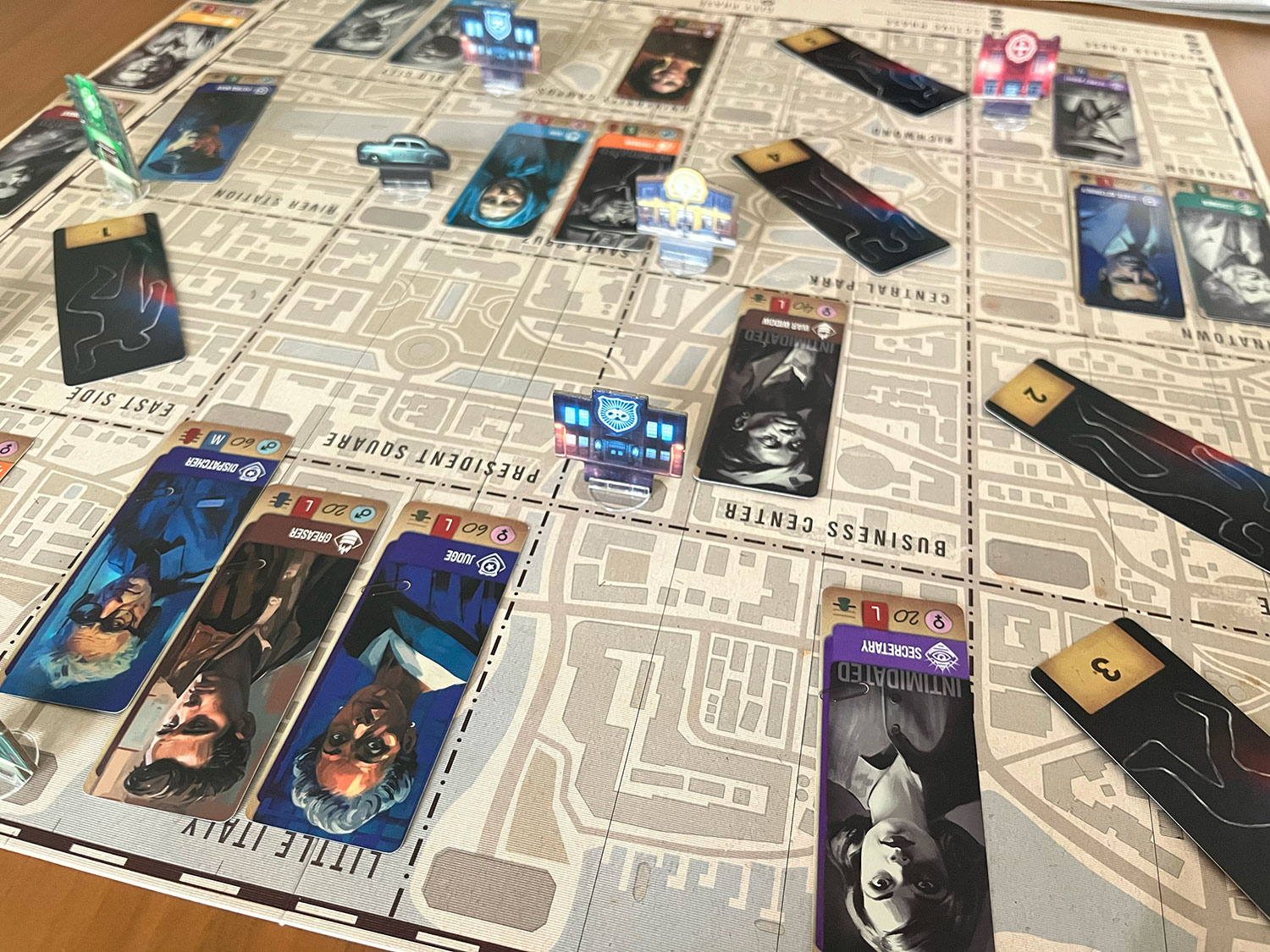
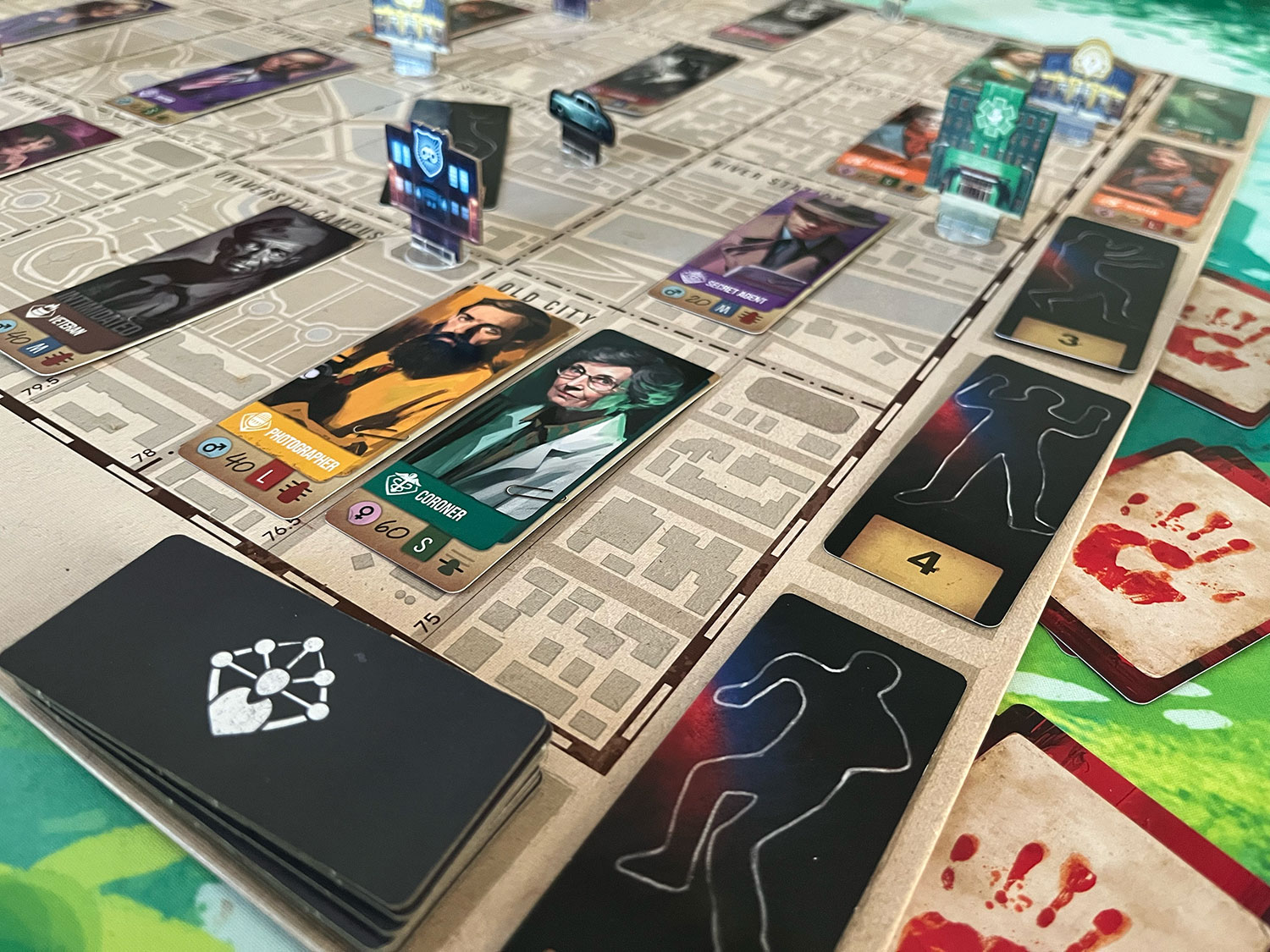
The art for Intent to Kill is a genuine standout. Designer Arthur Khodzhikov and the Owl Agency have done a fantastic job setting the scene. The board and cards evoke a mid-20th-century metropolis with characters to match, and the whole package succeeds in delivering the noir theme it’s going for.
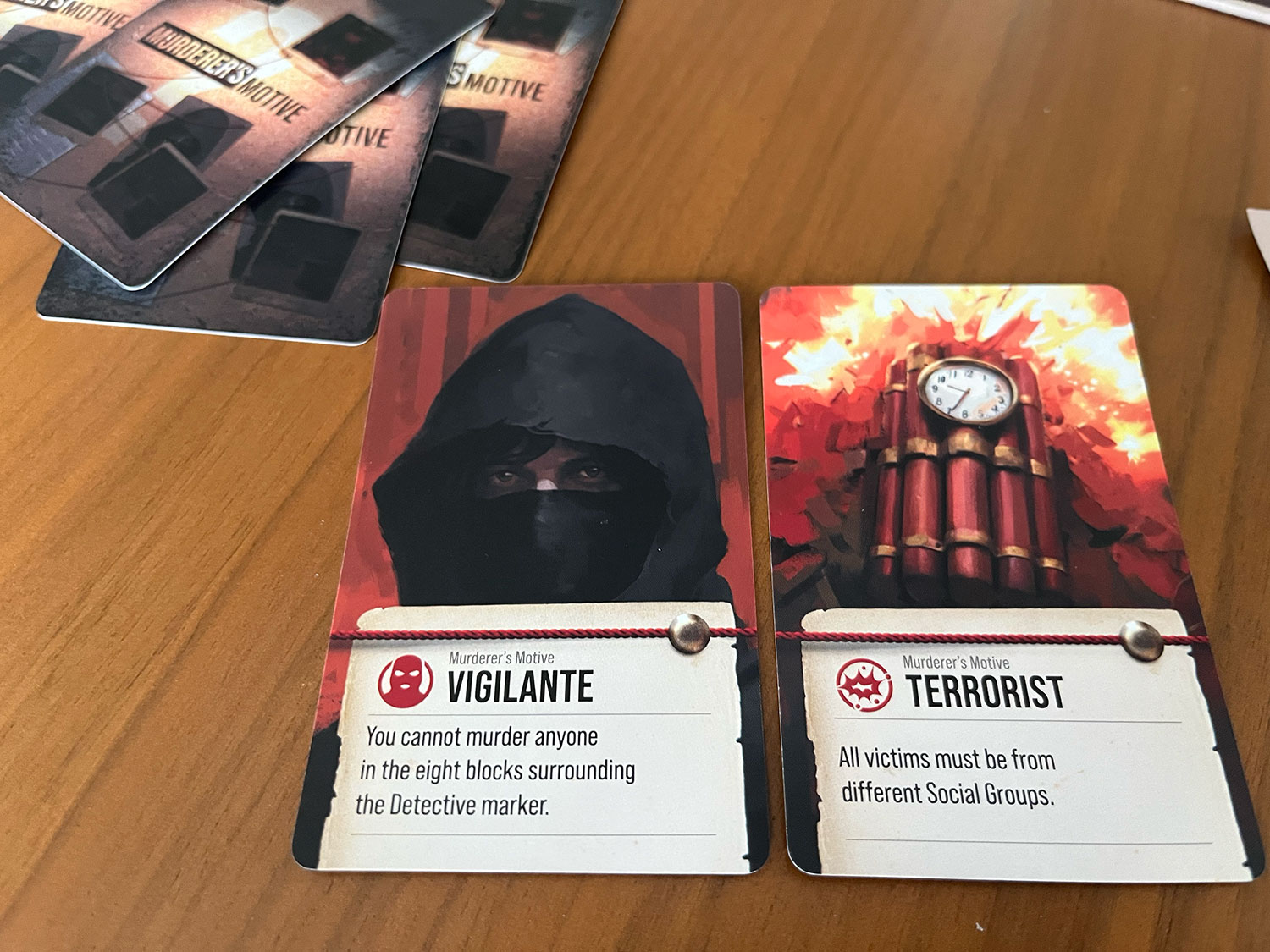
The gameplay, unfortunately, feels lackluster by comparison. The detective role carries the majority of the active decision-making that is the heart of the game. Meanwhile, the murderer is largely playing defense, reacting rather than driving the action. More than one person in our group noted that playing the murderer felt boring, and that’s a hard problem to overlook in a two-player competitive game. That’s not to say there’s no opportunity to put the detective off the path, though, through character movement and witness intimidation. Just that we don’t find these strategies very compelling.
In every playthrough we had, regardless of who was playing the detective, the experience ended the same way: a mounting sense of “I have no idea who the murderer might be, but it’s the final round so I suppose I’ll guess it’s the waitress with the maniac motive.” And somehow that hunch won. When what feels like a coin flip keeps coming up heads, the detective’s win feels less satisfying than it should.
That said, I’ll acknowledge my table leans toward people who don’t love deduction games, and that may have colored my experience as well. For greater context, I really enjoy Watergate, a tight tug-of-war, but my husband doesn’t. And, we both very much enjoy Pagan: Fate of Roanoke, which pulls off accessible asymmetry without either player feeling left out. So my lukewarm reaction here isn’t a dislike of asymmetry or two-player games for that matter.
For the right group, Intent to Kill may offer a theme and gameplay that appeals. Looking past my own feelings about the game, I can see that it offers genuine replayability and content depth. A variety of motives, identities, and play mode combinations means the game may feel different across multiple plays.
Final Thoughts:
If the theme resonates with you and you can find a partner who’s equally invested in both sides of the asymmetry, there’s a lot of potential in Intent to Kill. The art and atmosphere are genuinely excellent, and the variety is there for a willing pair to explore. But for me, the imbalance between roles and the underwhelming payoff of the deduction loop weren’t enough to keep me coming back.
Final Score: 3 Stars – Playing as the Murderer may have you wandering from the table; playing as the Detective may leave you puzzling through a dissatisfying finale.
 Hits:
Hits:
• Art and Production value
• Noir Theme
• Replay value and variation
Misses:
• Imbalanced player roles
• Dissatisfying deduction loop
• Rule complexity relative to gameplay payoff

Source: Board Game Quest

