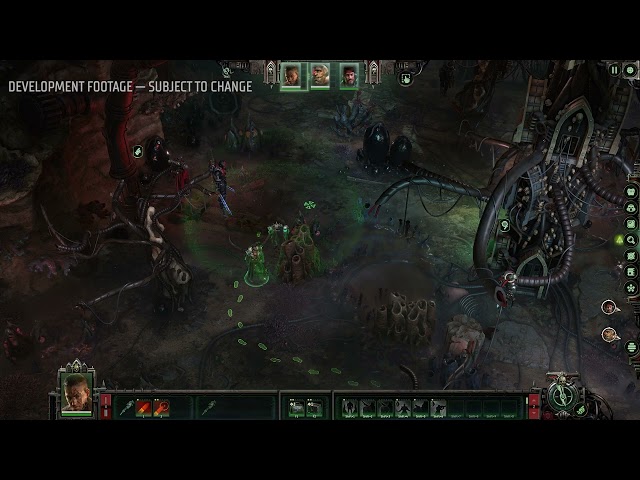
One thing above all is clear to me from my recent chats with Anatoly Shestov, executive producer of Warhammer 40k Dark Heresy at Owlcat Games. He knows exactly the game he wants to make, and isn’t afraid of the expense in blood, sweat, and dollars. For him, building the whole game to fit its central Investigation mechanic (my favorite part by far) is essential to a story about the 40k Inquisition. But, when I ask him if it adds wild levels of development cost, it’s clear my fears on that front were dead on the money – pun intended.
“Yeah, it’s hell.” he tells me in a recent interview with Wargamer. “It’s like we opened Pandora’s box when we decided to make investigation as a sub system for the game.”
Normally, he says, “whenever you’re making a usual meta system, like space combat or a kingdom simulator… you’re making a separate entity.” But in Dark Heresy, investigating multiple, linked ‘cases’, with all their persons and places of interest, titbits of unverified information, and more, isn’t an optional sideshow. It’s become the main spine of the entire game, from the top level story down to moment-to-moment gameplay. “We’re making something that is inseparable, and this is an additional layer of complexity, additional cost to the design, to the implementation, to the QA,” he explains.
That’s not surprising, when you think about it. In your standard videogame RPG, questlines might have multiple paths and outcomes, or even dead ends and red herrings – but, generally speaking, the game sets them in front of you, in order, and you progress through them. In Dark Heresy, the narrative stepping stones (both in the big story, and in the little ones along the way) are almost all based on information you’ve got to find out. Not only that, but they can play out differently based on how you interpret the evidence, and what you decide to do with it.
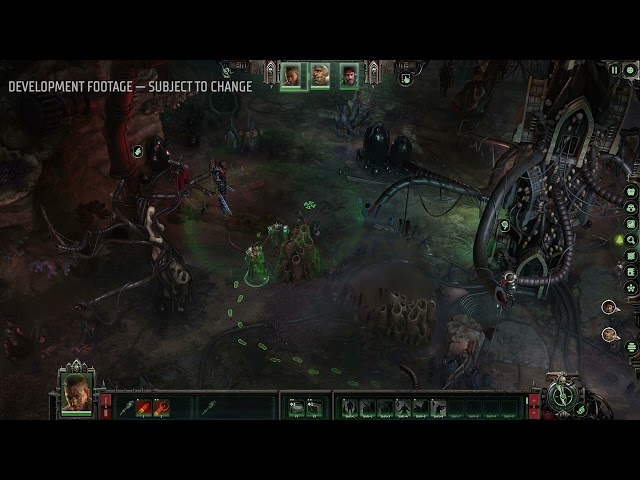
As we reported last week, Shestov is very clear that these inquisitorial investigations aren’t about finding the truth, but rather weaponizing information in ways you see fit, and dealing with the consequences throughout the game. It’s not about right and wrong answers to each mystery, he says; it’s about finding the answers that suit your purposes. That’s deliciously political, but it’s also a fiendish development puzzle.
“It’s not easy to to decide how you should frame any piece of evidence, or for the player to understand what’s important,” Shestov says. “There always needs to be empty space for you to make your own deduction. The whole investigation game is a game for the player, not for the character.”
That seems like a recipe for a frightening number of tree diagrams and post-it notes stuck on studio walls, I tell him – and he’s not shy in agreeing. “It’s a huge experiment for us,” he admits – “it’s a really expensive experiment.”
“And we’re sticking with it because it’s not just technology, it’s not just graphics or the combat system design, where we are stepping up for this game,” he adds. “No, the narrative, the whole meta system design are things we’re stepping up too.”
“It’s not so obvious how expensive, difficult and important [that is]. But if you look at the budget, and how much it costs comparable to other things in the game, it’s a pretty hefty chunk of the budget to make the story.”
Taking the risk

As a long-time Warhammer 40k nerd who’s just finished his third listen-through of Dan Abnett’s Eisenhorn, Ravenor, and Bequin book series all about Inquisitors squashing heresies in the Imperium’s grayest areas, this is – of course – music to my ears.
I’m all for blockbuster AAA videogames that recreate the bombastic power fantasy at the heart of Warhammer 40k battles, in a way that’s fun for literally anyone who likes crushing skulls and blowing stuff up. But, as much as I adore Space Marine 2‘s gameplay and celebrate its success, its achingly banal, nothing-burger story almost brought tears of rage to my eyes. There’s so much more to Warhammer 40,000 than ‘deep voice punchy metal man good, aliens bad’.
Owlcat’s 2023 smash hit Rogue Trader showed us just how much the CRPG genre could do with 40k storytelling – and its excellent sales proved there’s a growing market for it. But I have a worry that going ‘higher concept’ – making detective work the primary gameplay loop instead of Rogue Trader’s more accessible ‘explore the galaxy, kill baddies, get power’ schtick – might alienate as many players as it enthuses.

I ask Shestov the obvious, if bloody minded question: why not just make Rogue Trader 2? Why take the risk? He’s completely sanguine about it – but forceful and remarkably passionate about the reasoning.
“Rogue Trader, compared to Pathfinder Wrath of the Righteous, was a huge risk, too,” he says – “we changed lots of things.”
“Anytime we’re doing something new, we ask ourselves not about what’s the easiest way to achieve it. We ask ourselves about what would be the most precise way to express what’s important for us in this material.”
If there’s one thing we Warhammer nerds are tetchy about, especially when it comes to videogame adaptations, it’s faithfulness to the Lore (always a capital L). There are serious points to be won with us when a game’s creators demonstrate that they’re more motivated by fondly and accurately representing 40k’s history and themes than by money.

On that front, Shestov wins more points than most. His fan bona fides are rooted in one of the most narrative-fueled parts of the whole 40k oeuvre: the TTRPGs. His years spent roleplaying in Games Workshop’s grimdark future have clearly given him a love of the setting, but also a marked seriousness about its importance.
“I’ve played more than 1000 different tabletop [RPG] sessions of Warhammer,” he tells me – “from different lines, from Black Crusade, to Only War, to Deathwatch – not just Rogue Trader or more traditional ones”.
“And there are some things that are important for me,” he says, with characteristic intensity. “Not as a child, like ‘oh, I’m having fun’. No, there are things that make these [roleplaying games] important, meaningful, compelling, deep, and true.”
“We’re asking ourselves, what would be the most true way to express these things,” he tells me – “and afterwards, we’re just working in production hell for several years to deliver this”.
Doing it for themselves

It’s clear that’s why Shestov and his team are so committed to making the Dark Heresy they feel most accurately represents the Inquisition, rather than a Dark Heresy that basically any gamer might feel comfortable playing.
“I’m not making a game for ‘people’ to play,” he says frankly. “I’m not making a game to earn money. I’m making a game that I would play with pleasure.”
That, he’s already told me, is costing Owlcat a lot of money and time. He’s fine with that. “We’re not just working for the money, we’re not just working work hours,” Shestov says. “We are making things for ourselves. And because we are good professionals, these things would be selling – because we make good things!”
A rather auteurish and conceited sentiment, one might say, marred as we all are by the skepticism of living in a cultural age where superficial licenced cash-ins are rife, and AI is burning down the authenticity of all human created works anyway. And I might agree with you, had not Rogue Trader been such a brilliant, evocative, and lore-loyal tour de force. I’m inclined to believe in Shestov’s vision for Dark Heresy.

It helps, of course, that I’m literally in the bullseye of his target audience, and that I’ve already played the closed Alpha and fallen in love with the Investigation gameplay at the core of Owlcat’s big risky bet. But Shestov’s fiery focus on it as the Right Thing To Do is inspiring in itself.
Just you wait until we get to how he talks about the story, the Inquisition, and why it all matters so much! That’s coming soon in the third and final part of our interview. In the meantime, if you’ve got questions about Dark Heresy, or just want to chat about Warhammer 40k lore for hours on end, join the free Wargamer Discord community and hit me up. My favorite Warhammer 40k faction is Black Templars because I hate them, and my least favorite of the primarchs is Perturabo, for reasons that should be obvious.
 Source: Wargamer