 Working in the biomedical field, I’ve developed a pretty strong stomach for blood, guts, and gore. But going fishing? Eughhh! That’s where I draw the line for grossness. Shoving a hook through your helplessly wriggling bait, smelling the putrid sourness of dying flesh as fish get gutted, and having hours on end of nothingness to distract from these horrors is an experience I’d rather not repeat.
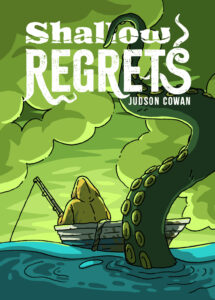
Judson Cowan’s filler game, Shallow Regrets, thus captures my feeling about fishing perfectly. Described as a “horror fishing game,” Shallow Regrets has 2-3 players competing over 15 minutes to catch everything from fish, rotting atrocities, and monsters from the card-based sea in an attempt to net the greatest number of points.
Gameplay Overview:
The “sea” of Shallow Regrets is comprised of 6 stacks of cards. On their turn, a player will go fishing by drawing any two cards from the sea.
Players must catch one of the two fish, if able, by comparing the required fishhooks (0-5) with what they currently have on their existing fish. The other fish will be returned to the sea.
Once players have caught fish, at the beginning of any future turn (prior to fishing), they may tap any of the caught fish in their collection to trigger its one-time special ability.
Gameplay continues until all fish have been caught.
The player with the greatest point value on their caught fish wins.

Game Experience:
Shallow Regrets is an 18-card wallet game that is easy to transport, teach, and set up. All players start with 0 fishhooks, so they should be aiming to catch fish whose card backs show small shadows, indicating that those fish require 0 hooks to catch, in the early-game. These fish are worth -1, 0, or 1 points, but almost all of them provide 1 or 2 fishhooks, which will allow you to hopefully capture better fish on later turns.
The other types of card-backs contain progressively bigger shadows and indicate either “1-2” or “3-5” fishhooks will be required to catch the fish on their reverse sides. There is definitely an element of push-your-luck, as you race to go fishing for the limited number of bigger fish, worth proportionally greater amounts of points. However, if you go fishing for a “1-2” size fish with only a single hook in hand, you have a 50% chance of ending the turn with no new fish (or fishhooks) if both of the fish drawn that turn require 2 fishhooks.

This is where some of the single-use abilities come into play. Several of the small, low-value fish increase your odds of success while fishing by letting you draw extra cards or peeking at certain cards before you go fishing. Choosing when to trigger these single-use abilities can be important; do you boost your fishing abilities early game so you can quickly accumulate hooks, or late-game to ensure catching a higher point-value beast? It’s also worth noting that several cards have “take-that” effects, such as forcing an opponent to exhaust one of their fish so that they’ll never get to use its special ability. Players will often use special abilities earlier than desired for fear of losing the abilities altogether in an attack.
There are also some abilities that simply sow chaos. Four of the cards mandate some sort of fish-swapping among players. One card allows reshuffling and resetting all the sea stacks, so nobody knows where any of the desired fish are located. There’s only one card that provides any level of defensive protection from negative or swapping effects, and this protection only lasts for one turn.
The result of all these effects is that the game feels rather chaotic and luck-driven. Sure, there are occasionally some interesting decisions to be had, but usually, whoever gets lucky enough to catch a fish with a good ability (often the first player), will use that ability to prevent other players from catching a break. This runaway leader problem is especially pronounced at the 2-player count.

In one such two-player game, my first caught fish was a stingray that let me exhaust my opponent’s card. So, of course, as soon as my opponent caught their first fish that could potentially be used to cause me harm, I exhausted it. The next time they caught a useful fish, I promptly used a different ability that swapped that fish with one of my useless ones. And so on and so forth until my opponent was laughing in frustration, saying, “I literally cannot do anything to stop you. Do we even need to finish this game?”
So for those who enjoy ample chaos, luck, and take-that in strategy games, you may enjoy this one. If you prefer more open information and consistently meaningful decisions, sail far, far away.
One final note is that the artwork for this game, also by Judson Cowan, is fantastic. Half of the cards depict real-life sea creatures, although the chosen selection is less Disney-worthy Clown Fish and more Barracudas bearing their teeth, a Lamprey with its suction disk ready to latch, and a demented-looking Great White Shark. The other half of the deck, officially described as “foul,” is where the horror peaks. These “fish” include a severed human foot with bone protruding, a floating mass of eyeballs, some vaguely aquatic mutant beasts, and a mermaid that looks more like an evil frog-dragon.
Final Thoughts:
Shallow Regrets is an 18-card pocket-sized game that thematically has players fishing through cards for points and abilities with which to best their opponents. The artwork is incredibly rendered, both thematically and visually, capturing the horrors of the sea. As a fishing game, some luck is to be expected, but the special one-time abilities of the cards introduce abundant take-that and chaos. Timing of these abilities can matter, so there are occasionally some interesting decisions, but this is definitely a game that feels more random than strategic. It is more likely to resonate well with fellow fans of Exploding Kittens than Castles of Burgundy. At least for this reviewer’s tastes, it fully lives up to its shallow title, and maybe the regret part as well.
Final Score: 2 stars – a travel-sized horror fishing game where the art may be its best attribute
 Hits:
Hits:
• Easily transportable
• Fantastically horrifying artwork
• Simple rules
Misses:
• Too much luck and chaos for some
• Ample take-that can feel mean
• Runaway leader problem

Source: Board Game Quest