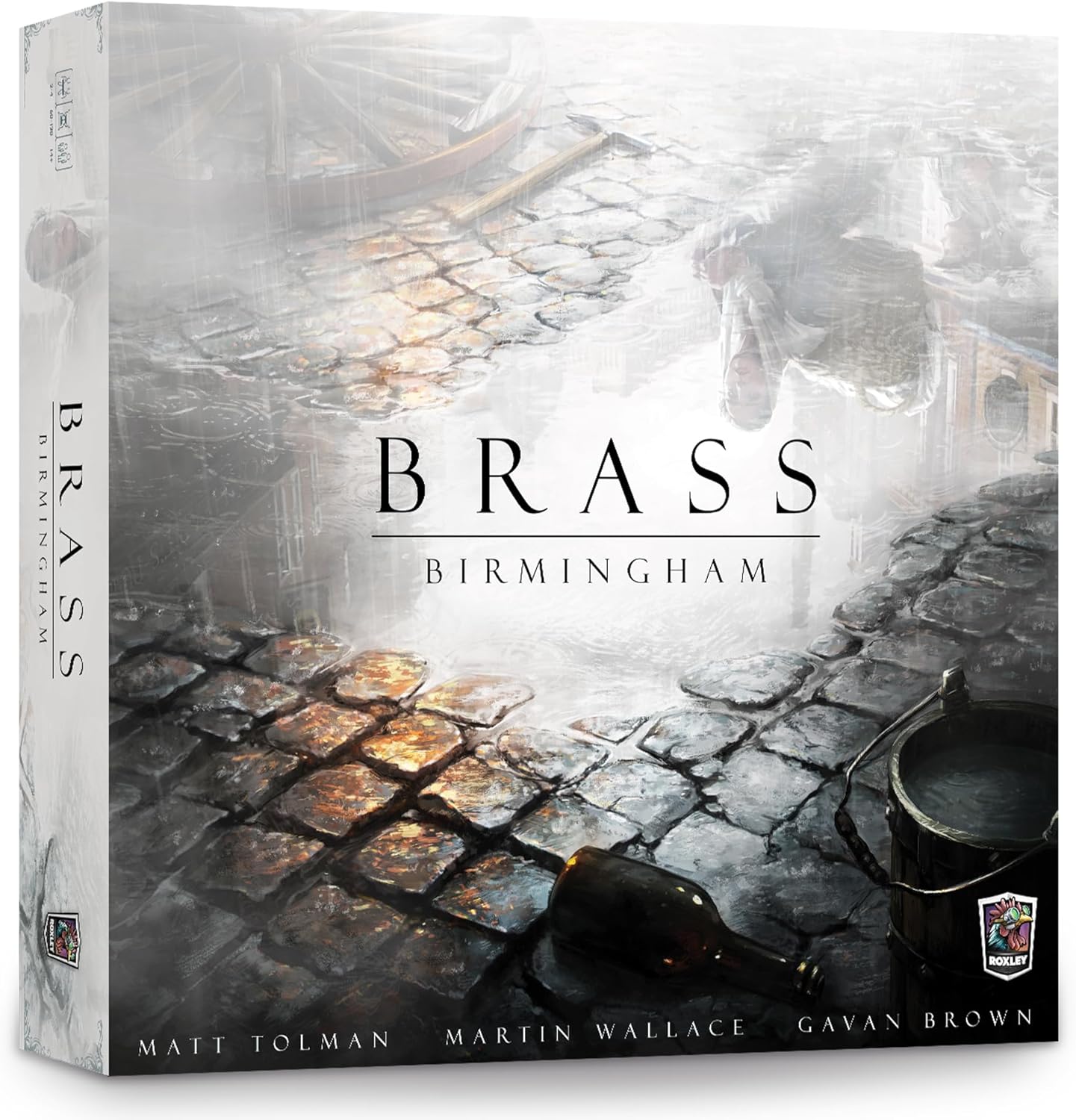
In Brass: Birmingham, players build the most powerful industrial revolution business through networking, selling, and cut-throat strategy.
Brass: Birmingham is a game of entrepreneurship and business expertise in the Industrial Revolution era England. Players will expand their personal empire by developing 1700 and 1800 industries, including cotton, coal, iron, pottery, brewing, and manufacturing. And all of this happens on a gorgeously illustrated playing field.
| Quick Guide | ||
|---|---|---|
| Mechanics | Chaining, Hand Management, Variable Set-Up, Market & Loans | |
| Players | 2 – 4 Players, Age 14+ | |
| Playing Time | 60 – 120 Minutes | |
| Similar Games | Age of Industry, Through the Ages | |
| Publisher | Roxley |
Brass Birmingham Overview
The sequel to the 2007 game, Brass, Brass: Birmingham is a competitive game of building businesses and developing various industries in England between the years of 1770 and 1870. Players establish their industries, build up their reputations, and find ways to make both the highs and lows of the market work in their favor.
Just like business in the real world, Brass: Birmingham is a highly competitive game where networking, strategy, and managing your resources are of the utmost importance. It’s a board game that manages to build its own robust economy and dynamic gameplay, yet has deceptively straightforward rules.

Brass: Birmingham is adored by fans with a #1 rank on BoardGameGeek, and critically with seven different board game award wins between 2018 and 2020. It’s universally considered a fun, engaging, and beautifully designed board game with a surprising level of depth that players need to check out for themselves.
How To Play Brass: Birmingham
Brass: Birmingham is a game played over two eras; the Can Era – ranging from 1770 to 1830, and the Rail Era – ranging from 1830 to 1870. To win, players earn victory points, which are tallied up and scored at the end of each era.

On each turn, players may perform a total of two actions, which include Build, Network, Develop, Sell, Loan, or Scout. During these actions, players will discard or draw cards to maintain eight in their hand, and account for the money they’ve spent. These actions will all help players build and develop their various industries around the city. At the end of the round, players will determined the play order for their next round and collect the money they made throughout the round.

After each round, players will count up their victory points. These are earned for canal or rail links, industry tiles, money, and income level. Points can also be lost for money shortfalls. At the end of both eras, the player with the most victory points is declared the winner.
Should I Buy This Game?
Brass: Birmingham seems like a game that would be borderline overwhelming to play. But it’s shockingly simple in how it breaks turns and round down into a quick list of actions. It’s also a hugely popular game, winning many awards and having overwhelmingly high reviews on multiple websites.
But should you buy it? I want to say yes. I really think that if you do buy it, you’ll enjoy playing Brass: Birmingham as much as everyone else. But board games games can be a little expensive, and this may not be where you want to spend your money. And if that’s the case, definitely go to your closest board game cafe and see if Brass is available to play there, and start your own industrial revolution era business.

Please note that BoLS may earn a commission when you purchase through links on our site.
Don’t Miss:


Source: Bell of Lost Souls