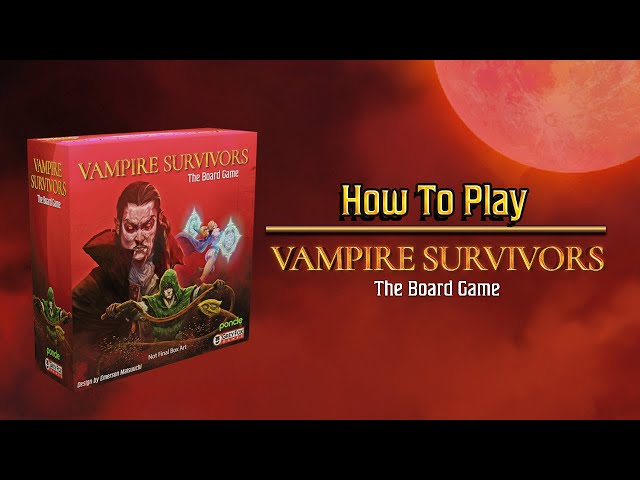
Announced in August 2025, the news that the roguelike hit Vampire Survivors was being converted into a deckbuilding board game came as quite the surprise. Of course, Vampire Survivors has massive name recognition, as a game so popular it inspired an entire subgenre of bullet heaven or ‘Survivor-like’ titles. But despite this obvious draw, it was hard for me to see how the frantic, button-mashing gameplay of Poncle’s breakthrough title would make sense on the tabletop.
So as the Kickstarter drew to a close last month, with close to $600,000 raised, we spoke to the game’s designer Emerson Matsuuchi and Josh Lobkowicz, head of Game Development at Grey Fox Games, to find out how the Vampire Survivors board game seeks to be as faithful as possible to its source material.
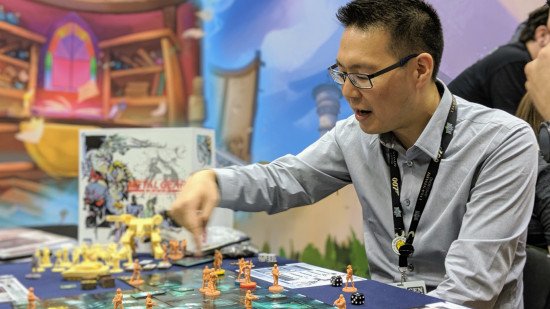
As a long-standing designer with dozens of titles under his belt, it’s not too surprising that Vampire Survivors isn’t Matsuuchi’s first video game adaptation. In fact, he’s the brains behind the Metal Gear Solid board game that came out last year.

While Metal Gear Solid and Vampire Survivors are very different video games, and the adaptations presented different challenges, Matsuuchi says the process was in some ways similar. “[It] starts with understanding the fandom and what makes the video game special,” he explains, whether that’s stealth and story or addictive bullet-hell gameplay.
He adds, “While designing this game, we wanted to have as many of the elements from the video game ‘ported’ to the board game. But the tabletop adaptation will always have limitations on components. It’s a tough set of decisions to determine what are the most important aspects of the video game to include in the product.”
To make a tabletop Vampire Survivors, the designer thought about the decision points players have in the video game. “So the goal for a board game adaptation was to have the players consider their movement, attacks, and upgrade path, while streamlining the other elements so the players focus on the fun decisions, like the video game,” he explains.
Lobkowicz of Grey Fox Games adds that: “You don’t want players to have to do the work that the computer normally does lest they find themselves caught up in upkeep rather than enjoying the experience.”
Lobkowicz says Emerson first introduced a system of pushing stacks of enemies in from all four sides of the board after every player’s turn, increasing the size of these over time. With this system “we knew we could capture the claustrophobia of ever increasing hordes of enemies.”
One of the addictive things about Vampire Survivors, that lets it worm its way into players’ brains and keeps them coming back for more is its upgrade system, which changes up the experience with incremental unlocks over time.
As Lobkowicz explains, the board game introduces an ‘Achievement Deck’ which works much the same way. Players have particular goals to achieve beyond just surviving, and if they pull these off they unlock new weapons, upgrades, and characters to play.
“I think this is one of the more unique aspects of the board game,” says Matsuuchi. “The players won’t be able to see everything the game has to offer in a few games.”
Josh Lobkowicz says Grey Fox worked closely with Poncle, and wanted to closely follow not just Vampire Survivors’ gameplay, but also the philosophy of the devs when it came to providing value for players.
That’s one reason why the devs bucked a trend and brought their tie-in title to Kickstarter with zero stretch goals. A timed unlock approach would reveal content from the game as the campaign wore on, but there was nothing that could be unlocked by players by raising more money.
On the subject of stretch goals, Lobkowicz says, “I think they are a useful tool in the crowdfunding space but you have to be honest with them. Traditionally, stretch goals are tied to funding amounts and when we use stretch goals like this we always try to make them reflective of what is possible.
“What I mean by that is that reaching the specified funding goal should allow us to add something to the game that would have been cost prohibitive to add if we did not reach that amount and in this case there simply wasn’t much that we could do that fit that description.” For instance, expensive plastic minis are a common stretch goal offered by Kickstarter games, but Grey Fox felt that standees were a better option for representing the art style of the source material.
Despite this, Lobkowicz says he wasn’t able to add everything he wanted to the base game, but there’s plenty more that could come in later expansions. Hint, hint.
Share your thoughts on the Vampire Survivors board game over at our Discord. Or check out our list of the best board games of all time.
 Source: Wargamer