When the rules and model range for Trench Crusade appeared on Kickstarter in 2024, no-one was prepared for how popular the new miniature wargame was going to be, least of all the developers. Against a target of $66,666, the campaign raised $3,000,000, annihilating the team’s wildest expectations and hurtling them into the unknown. In the year and change since the Kickstarter wrapped, how has the wreckage from that initial blast settled?
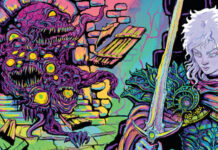
Like most overnight success stories, Trench Crusade took years to make. It began with the visions of concept artist Mike Franchina, who developed the setting as a private domain for “Fucked up religious freaks” and other artwork he couldn’t get away with in his videogame industry day job. The Trench Crusade universe imagines an alternative earth locked in perpetual all-out-war against the forces of hell, with a mixture of dieselpunk technology, religious iconography, and grotesque body horror.

In the summer of 2022, UK-based sculptor James Sheriff ran a Kickstarter campaign to create a small range of resin miniatures adapted from Franchina’s artwork. During that campaign, Sheriff announced that the games design legend Tuomas Pirinen was working with the team to turn Trench Crusade into a miniature wargame.
With most of his career actually spent in the videogame industry, Pirinen’s most significant tabletop design credit was 1999’s Mordheim, an apocalyptic fantasy warband game set in the Warhammer world. Though long out of print, Mordheim has a cult following, and Pirinen is something of a rockstar to these core fans – they were eager to see what the author of one of the best miniature wargames ever would do next. They formed the kernel of a growing community, playing the free beta rules for Trench Crusade with their own kitbashed miniatures.

Producer Jamie Parsons joined to organise the second Kickstarter. Expectations were modest. The main goal was to make the game playable, with a printed rulebook, STL miniatures for players to print on home, and a print on demand service for anyone who didn’t have a printer. In deference to the DIY community that had supported the game, the newly formed Factory Fortress Inc pledged that the game’s living rulebook would remain free in perpetuity. Various open licensing tiers would be available for other companies to make products compatible with Trench Crusade, from ‘compatible’ products through to full third-party expansions to the base game.
It was a plan to build a game that did not need a huge customer base to survive. It was not a plan for handling three million dollars of pre-orders.
There’s always a gap between the end of a Kickstarter and fulfilment, a moment where customer expectation is at its highest but the company is least able to fulfil it. Though the living rulebook was available and miniature STLs didn’t take long to arrive, the world was hungry for more Trench Crusade, and the team was busy working out how to fulfil a Kickstarter dozens of times larger than predicted.

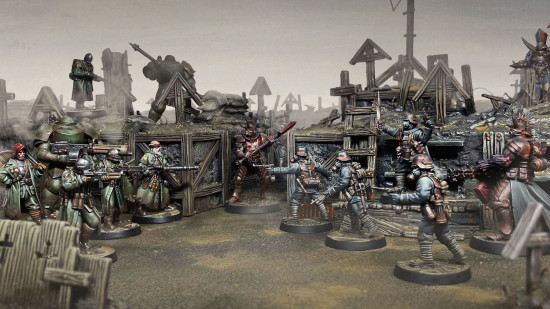
Third parties were more than happy to plug the gaps. I won’t list them off – just browsing MyMiniFactory or other 3D model marketplaces will reveal hundreds of miniatures based on Trench Crusade’s weird horror dieselpunk holy war aesthetic. Some of them are official partnerships, like The Red Brigade by Westfalia, with accompanying rules expansions – many more are just obvious model substitutes. My Black Grail plague warband is from a mixture of sources, printed before the official STLs were ready.
To my mind, the most telling piece of unofficial support for the game is Wargames Atlantic’s Trench Missionaries, the first hard plastic miniature kit released for Trench Crusade. People don’t make molds for casting plastic miniatures on a whim – check out this interview with US entrepreneur Daniel Block to learn just how much absurdly expensive they are to make.

The original $66,666 crowdfunding target for the Trench Crusade Kickstarter could have been blown on just a handful of molds for plastic kits – it seems unlikely that the team ever thought they would be an option. But Factory Fortress has begun to adjust to its new reality.
Wargamer was the first to report on the team’s plans to start making plastic miniatures in partnership with Archon Studios, and plastic minis for the brand new Prussian sub-faction for New Antioch were revealed during Essen in October 2025, a year after the game’s Kickstarter launch. These hit shelves before all of the pledges from the Kickstarter were fulfilled, which is either testament to an incredibly rapid turnaround from Archon Studios’ mold makers, or evidence of disorganised Kickstarter fulfilment, depending on your patience.

Trench Crusade isn’t a scrappy game reliant on a small core of dedicated fans – it’s a brand with serious clout. But it’s still run by artists. I received my printed rulebook from the Kickstarter campaign at the start of the year, and it is, front to back, a work of art, packed with never-seen-before illustrations by Franchina and many other talented artists. Even the end-papers are illustrated, printed with absurdly detailed maps annotated in Latin.
Trench Crusade rulebook art spread – warriors of hellPirinen’s rules are superb, in ways I can get deeply nerdy about – but without the word count to (for example) expound on how many gameplay decisions the rules for dashing create, or how the game creates distinctive unit profiles from such a tiny selection of unit statistics, I’ll simply call them ‘flavorful’. Every faction, and even subfaction, feels distinctive from the rest – and thanks to Franchina’s unrestrained designs, they tend to feel different from factions in any other wargame, as well.

The original pledge to keep the rules a free, living document still holds true. I interviewed ex-GW designer Jervis Johnson earlier this month and discovered he was involved as an editor and co-ordinator – I got the impression that the veteran was bringing some much needed pruning to a creative garden threatening to run rampant.
The tension, I think, remains, between the anarchic origins of Trench Crusade, and the need for Factory Fortress transform into something that can meet the obvious demand that fans have demonstrated. There are plans to translate existing models into plastic releases which will stand alongside the existing STLs – but what the schedule is isn’t clear, and not because the studio is especially tight-lipped. It’s in flux.

That feels appropriate for something based on Mike Franchina’s artwork. An amalgam of aberrant creative minds, the focal point of a summoning ritual drawing pledges from thousands of the faithful. Now, a period of transformation – swelling, splitting, shedding skin, growing new limbs and aberrant organs. What will emerge? Something terrible and new, I hope.
If you’re a Trench Crusade player, I want to see your freaks. Miniature pictures always welcome in the Wargamer Discord community.
 Source: Wargamer